
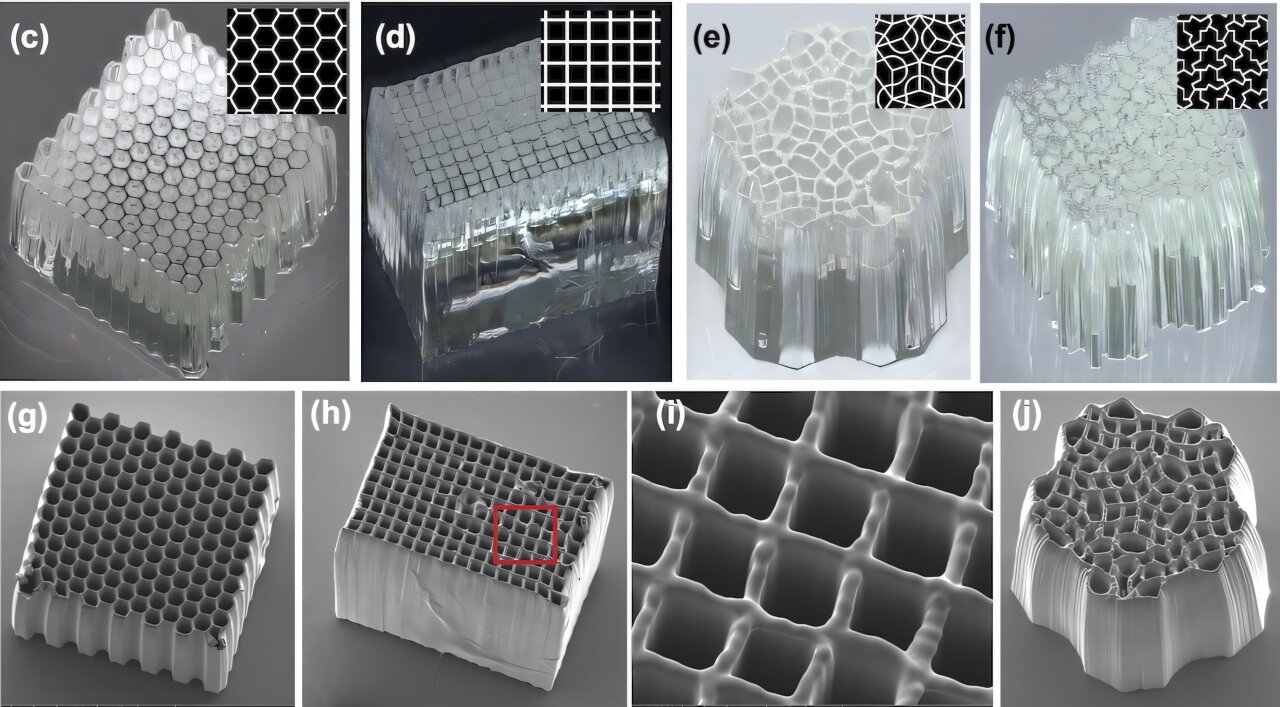
Holographic 3D printing isn’t just another incremental step forward — it’s one of the most genuinely disruptive advances additive manufacturing has seen in decades. Instead of stacking an object slice by slice, this approach forms an entire three-dimensional structure through a single holographically shaped burst of light. What you get on the other side is dramatically faster production, stronger internal geometry, fewer defects, and a level of microscale precision that conventional printers simply can’t touch.
Recent research shows that carefully engineered holographic light fields — paired with nanopatterned optical masks — can fabricate complex microstructures in roughly 20 seconds. And they do it while cutting out most of the structural weaknesses that have plagued conventional stereolithography from the start.
What Is Holographic 3D Printing?
It’s an optical manufacturing process. One that uses precisely engineered laser light to solidify photosensitive material throughout an entire volume at once, rather than curing one thin layer and then moving on to the next.
Unlike traditional additive manufacturing, the printer doesn’t work sequentially. It calculates and projects a complete optical pattern directly into a liquid photopolymer. Every illuminated region hits its curing threshold at the same time, producing the finished structure in a single exposure.
The technology pulls together:
- Computational optics
- Laser engineering
- Holography
- Photopolymer chemistry
- Nanofabricated optical elements
- High-precision lithography
That kind of multidisciplinary convergence is what pushes manufacturing speed into a completely different category — without sacrificing geometric accuracy.
How Conventional 3D Printing Works
Traditional 3D printers build objects sequentially. That’s really the whole story.
The workflow goes like this:
- Slice the digital model.
- Print one layer.
- Cure or solidify that layer.
- Move upward.
- Repeat hundreds or thousands of times.
Effective? Sure. But it comes with real costs.
| Limitation | Effect |
|---|---|
| Layer boundaries | Mechanical weakness |
| Long print times | Reduced productivity |
| Stair-step surface finish | Additional post-processing |
| Material shrinkage | Dimensional errors |
| Bonding inconsistencies | Structural defects |
Every single layer is another chance for something to go wrong.
How One-Shot Holographic Printing Eliminates Layering
Single-exposure holographic printing doesn’t just improve the layering process — it removes it entirely.
Instead of stacking slices, the printer exposes the whole printable volume at once. Laser energy goes exactly where polymerization needs to happen. Regions outside the designed geometry stay liquid and get washed away during development. Simple as that.
What you end up with:
- Continuous internal structures
- Uniform polymerization throughout
- Reduced stress concentrations
- Improved dimensional consistency
- Faster production cycles
Core Components of a Holographic Printer
A complete holographic printing system typically includes the following.
Laser Source
Provides coherent light with enough intensity to drive polymer curing throughout the target volume.
Nanostructured Optical Mask
This is where things get interesting. A specially engineered optical element shapes the incoming laser into the required holographic field. Rather than simply blocking unwanted light the way conventional masks do, the holographic mask redirects energy into complex three-dimensional distributions. It’s a fundamentally different philosophy of light control.
Photosensitive Resin
Most demonstrated systems use photopolymers like SU-8. These materials only harden where sufficient optical energy actually lands.
Computational Design Software
Algorithms calculate the holographic phase distribution required to generate the desired internal light pattern. This is where a lot of the heavy lifting happens — before any light ever reaches the resin.
Development Process
After exposure:
- Uncured resin washes away.
- The solid structure stays behind.
- Minimal finishing is required.
Clean. Efficient. Genuinely elegant.
The Science Behind Holographic Lithography
Traditional photolithography creates two-dimensional patterns. Holographic lithography takes that same principle and pushes it into three dimensions.
Instead of projecting a flat image onto a surface, the optical system generates a complex interference pattern inside the material itself. Each microscopic region receives a carefully controlled light intensity. Locations that exceed the polymerization threshold solidify. Everything else stays liquid.
The result? Intricate internal geometries that are simply impossible with conventional masking techniques.
Why Diffraction Compensation Matters
Here’s a challenge that doesn’t get talked about enough: optical distortion.
As laser light travels through resin, scattering and diffraction blur the projected image. Left unaddressed, that’s a serious problem for dimensional accuracy. Researchers tackle it using nanopatterned diffractive masks that pre-compensate for those distortions before light ever enters the resin. The projection stays sharply focused across the entire printing volume. Not just near the surface — throughout it.
Advantages of Single-Exposure Holographic Printing
Extraordinary Speed
Objects that used to take hours can now be fabricated in seconds. Instead of repeating thousands of exposure cycles, you need exactly one — carefully engineered, then done.
Stronger Structures
No layer interfaces means no layer-interface failure modes. Finished parts show genuine structural continuity, with potential advantages including:
- Greater compression strength
- Reduced crack propagation
- Better fatigue resistance
Higher Aspect Ratios
Researchers have demonstrated structures with aspect ratios exceeding 120:1 while holding dimensional accuracy. That’s not a small feat.
Excellent Surface Quality
Without layer lines:
- Less sanding
- Reduced polishing requirements
- Better optical quality
- Higher manufacturing precision overall
Improved Manufacturing Efficiency
From an industrial standpoint:
- Lower energy usage
- Reduced print times
- Higher throughput
- Simplified workflows
Comparison: Traditional vs. Holographic 3D Printing
| Feature | Traditional Printing | Holographic Printing |
|---|---|---|
| Manufacturing method | Layer-by-layer | Single exposure |
| Speed | Minutes to hours | Seconds |
| Layer lines | Present | Eliminated |
| Structural continuity | Moderate | Excellent |
| Mechanical uniformity | Variable | Improved |
| Surface finish | Requires post-processing | Naturally smoother |
| Throughput | Limited | Very high |
Current Technical Limitations
Revolutionary? Yes. But let’s be honest about where the technology actually stands.
Current systems are best suited to elongated microstructures, not unrestricted three-dimensional objects of arbitrary geometry. Researchers have described many demonstrated structures as “extended 2D” — only two dimensions are fully programmable, and the third simply extends through the material thickness. True unrestricted volumetric fabrication is the target, and active work is pushing in that direction.
Other challenges that haven’t been fully solved yet:
- Resin compatibility
- Optical calibration complexity
- Scaling to larger volumes
- The cost of high-precision optics
- Computationally demanding design workflows
These aren’t dealbreakers. But they’re real.
Applications Across Multiple Industries
Microfluidics
High-precision microscale channels improve:
- Lab-on-chip devices
- Chemical analysis platforms
- Medical diagnostics
Biomedical Engineering
Potential applications include tissue scaffolds, cell culture platforms, drug testing environments, and regenerative medicine. Related holographic volumetric printing research has already shown meaningful efficiency gains for tissue-like structures — the trajectory here looks promising.
MEMS Manufacturing
Micro-electromechanical systems demand micron-level precision. Holographic printing can fabricate sensors, microvalves, optical devices, and actuators at that scale.
Photonics
Applications include:
- Optical waveguides
- Microlens arrays
- Diffractive optical elements
- Light-management devices
Advanced Manufacturing
Industries with strong interest include aerospace, semiconductor manufacturing, scientific instrumentation, defense, and precision engineering more broadly.
Capillary Microstructures
Researchers have demonstrated microscopic tubular lattice structures capable of moving liquids through capillary action — no external pump required. Compression testing showed solid mechanical durability for these fabricated arrays, too.
Potential uses span medical diagnostics, ink delivery, cooling systems, and chemical reactors.
Future Improvements
The research community is actively working on:
- Full volumetric free-form printing
- Larger printable volumes
- Faster optical computation
- Multiple printable materials
- Higher optical efficiency
- Better phase modulation
- Increased manufacturing resolution
It’s worth noting that earlier research already suggests holographic phase modulation significantly outperforms amplitude-only approaches on both light efficiency and resolution. That’s an important signal for where this field is heading.
Workflow of a Holographic 3D Printing System
Frequently Asked Questions
Is holographic 3D printing faster than conventional printing?
Yes — significantly. Instead of building thousands of individual layers, holographic systems cure the desired geometry in a single exposure, collapsing production time from hours to seconds for suitable geometries.
Does it completely replace conventional 3D printers?
Not yet. Current systems are optimized for specialized microscale fabrication and research contexts, not general-purpose desktop manufacturing.
Which materials can be used?
Demonstrations have primarily relied on photosensitive polymers like SU-8, though material compatibility research is ongoing and broadening.
Why are there no layer lines?
Because the object is polymerized throughout its volume simultaneously, rather than assembled from stacked slices. There’s no interface to see.
Which industries benefit the most?
Biomedical engineering, microfluidics, optics, semiconductor fabrication, precision manufacturing, and advanced research laboratories sit at the top of that list.
Conclusion
Holographic one-shot 3D printing rewrites the basic logic of additive manufacturing — replacing layer-by-layer fabrication with simultaneous volumetric polymerization. Through computational optics, nanopatterned holographic masks, and precision laser exposure, the technique delivers exceptional speed, improved structural integrity, and micron-scale accuracy that sequential methods can’t replicate. Current implementations are still focused on specialized microfabrication and haven’t yet reached unrestricted three-dimensional printing at scale — but the foundation is there. And it’s a strong one. Continued progress in optical design, materials science, and computational holography will expand both the capability and the commercial reach of this technology in the years ahead.
